Itinerant Londoner

What I learnt in North America

July 4, 2009 · 5 Comments

So. After nearly three months the first leg of my round the world trip is over, and I’m nearly a quarter of the way through. So what have I learnt so far?

Beautiful San Miguel de Allende from above

Beautiful San Miguel de Allende from above

I’ve learnt I don’t need to do stuff every day. Sure, there’s always something to see, something to do, but trying to cram too much in is just exhausting, plus it’s like stuffing yourself with sweets – it gets a bit much after a while and you stop appreciating it. When I start to feel like that, I just take a day or two off and do very little. Hang out on a beach, or enjoying cooling off by the fan in my room. Or just catching up with my blog.

The best way to enjoy a city is to wander around for hours, taking it all in, and discovering cool buildings, interesting shops, and the best street food. In fact, most museums have been a disappointment and I only visit now if they’re free or have been highly recommended.

Guanajuato, my favourite city so far.

Guanajuato, my favourite city so far.

Churches all start to look the same after a while.

So do Spanish colonial buildings. Best to break it up a little with some outdoor activities.

Kayaking across Lake Atitlan

Kayaking across Lake Atitlan

On that note, it’s the outdoor activities that are increasingly becoming my favourites – whether it’s hiking along canyons or up volcanoes, mountain biking around the countryside or learning to dive, most of my happiest memories so far have taken place away from towns and cities.

Learning Spanish has been incredibly worthwhile. It’s really helped with making the basics of travel a million times easier, but more than that it’s allowed me to have far more conversations with locals than I have ever had previously. It’s actually made me slightly worried that the Asian leg of my experience won’t be quite the same, as their languages are far harder to pick up. Although I’m considering learning a bit of Indonesian, as apparently it’s relatively easy to pick up the basics.

Never trust a local of one country to comment on the safety of another. Mexicans told me to avoid Guatemala like the plague. Guatemalans told me the same about Mexico. I felt completely safe the whole time in both.

I’ve become a bit of a Mexico bore. I loved the country so much I can’t stop talking about it. I need to cut down on this as I’m aware that when I hear other travellers doing the same (especially when comparing one country to another) it can be bloody annoying.

I’m not a budget traveller. I suppose it was too much to expect after living on a good salary in London for so long and treating myself all the time, and it’s turned out that more often than not, I’ll go for the first class bus over the local ones (I convince myself I’m doing it for security reasons but I know deep down it’s for comfort). I’m a rubbish bargainer (I need to spend more time with Israelis. By common consent they are the experts in this area). And I splash out on nice meals a bit too often (especially in the countries that don’t have a good street food tradition). Er, and I probably like my beer a little *too* much. But hey, I’m on holiday.

Despite being very relaxed I still walk too quickly. I don’t think that will ever change.

I’m not as good a photographer as I’d like to be. Hopefully that will come with practice (and to be fair to myself, I have improved a lot already I think).

Probably my personal favourite photo so far

Probably my personal favourite photo so far

I am addicted to chili. Countries without a good selection of spicy condiments will not be popular with me.

Most of all, I’ve been very happy to realise that this kind of travel suits me. I’m feeling ridiculously relaxed and happy, and moreso every day. One thing that has surprised me is that a few people have commented on how nice my smile is. Yes, that’s partly because I had my tooth fixed before I left so I’m less self-conscious about it, but I think it’s mostly because I spend a lot of time grinning from ear to ear. Some have commented on how cheesy my grin looks in photos but I don’t care. I’m loving it.

→ 5 CommentsCategories: Uncategorized
Tagged: , , , , , , ,

Art Deco Miami

July 2, 2009 · 1 Comment

Miami was never somewhere I was desperate to go to, but with my round the world ticket it was the easiest way to get from Central America down to South America. Once the ticket was booked I figured it would be nice to spend a weekend relaxing on the beach, and enjoying the benefits of being ina developed country for a few days, including things I used to take for granted like not worrying about tap water and flushing paper down the toilet. Other than that, I really didn’t know what to expect, other than being vaguely aware that it had some nice Art Deco buildings.

I had no idea there were quite so many – I spent most of sunday just wandering around the streets of South Beach, and there are hundreds of them. So many in fact, that despite being so beautiful there are actually quite a few, especially off the main streets, that are semi-derelict, which is a shame. Most of the rest have been very well-preserved and maintained, and it makes the whole area one of the most beautiful beach resorts I’ve seen.

Other than wandering around taking in the local architecture, I spent most of the rest of the time relaxing on the beach, which was mostly fantastic (the water was the warmest I’ve ever swam in), although I should have paid attention to the clouds on sunday afternoon, as when I was swimming quite far out from the beach a thunderstorm suddenly broke out, and by the time I made it back to the beach my stuff was soaked right through. Luckily my camera was wrapped in my towel and survived unscathed, but my ageing mobile wasn’t so lucky, and despite drying out for several days since, it’s not quite the same again and the battery dies very quickly after charging. Think I may need to invest in a new one (or maybe just buy a watch, seeing as that’s all I use it for).

The one big downside to my weekend was the cost. I knew it would be more expensive than Central America, and it was certainly a shock to the system: I totally blew my budget on every score – Transport costs were the highest yet ($14 a day), thanks to awkward flight times making public transport unfeasible and having to use an airport shuttle instead. $22 a day for the hotel is pretty reasonable for South Beach, but it’s still double what I spent in Mexico, my previous highest. Biggest of all was food and drink – nearly $70 a day, probably not helped by my Friday night out (at $7 a beer. Ouch). Total budget came in at $116 a day, which is not as bad as I was expecting, but quite a hit all the same.

You can see the full set of pictures here

→ 1 CommentCategories: Art & Architecture · USA
Tagged: , , , , , , , , ,

Honduras Round-up & Budget

July 1, 2009 · Leave a Comment

I’m not going to write a long post about my impressions of Honduras like I did for Mexico & Guatemala, as in my brief time in the country I didn’t get to see all that much and it’s hard to get a real feeling for a country based on just a couple of stops.

Sunset over Utila harbour

Sunset over Utila harbour

What I did see though I really liked. I was expecting it to be pretty similar to my previous stops, but it felt like the country had a very different vibe, a much more laid-back, tropical pace of life where no one ever seems to be in a hurry.

My first stop was Copan Ruinas, a little town near the border with Guatemala, most famous for its Mayan ruins, and in particular the intricately carved stelae that are dotted around between the pyramids. I’d love to show you photos, but after walking all the way from time I realised I’d forgotten to put the battery back in my camera after charging it. I won’t be making that mistake again.

Next stop was Utila, and after completing my dive course it was lovely to just spend a few days chilling out on the island. It’s a wonderfully relaxing place, which basically has just two real road on the whole island, and what little traffic there is consists of golf carts and quad bikes. No cruise ships visit the island, which helps preserve the tranquil air, and pretty much everyone on the island is there for one thing, which is pretty cool, as you immediately know you have something in common with everyone you meet, and everyone is always happy to chat about all the cool things they saw on the day’s dives. The island isn’t exactly famous for its beaches (especially compared to most Caribbean islands), but there are a couple of lovely little ones if you want to get away from the diving.

Utila beach

Utila beach

One of my other favourite things about Utila was the Jade Seahorse restaurant. With no guidebook I’d never heard about it before I got to the island, so when one night an English girl told me we had to go there because it’s one of the best bars in the entire world I was sceptical to say the least. Turns out I should learn to drop my natural cynicism from time to time. The whole place is a work of an American who spent eight years creating this little fantasy land out of broken bottles, sea shells, pieces of mirrors and any other junk he can find. The garden is laid out over several different levels, linked together by colourful staircases, little passageways, bridges and tunnels, all covered in a colourful mosaic of rubbish. Around the garden sit a few small similarly decorated cabins you can stay in, and at the top, suspended in the trees, is its bar, Treetanic. The whole place is captivatingly beautiful. It’s a really unique place, and I think the girl may have been right. Definitely one of the best in the world.

Jade Seahorse, Utila

Jade Seahorse, Utila

I definitely want to return to Honduras. I never got to explore the beautiful highlands to the south, which has some wonderful colonial towns and is the heartland of the country’s indigenous culture. The mosquitia (Mosquito Coast) area to the east of the country is supposed to be another highlight, one of the largest wildernesses of Central America.

There was one down side to Honduras though: it was my first budget fail. Diving may be cheaper in Honduras than most other places, but $269 for just four days is still way above budget. Add in the fact that Utila is an island where nothing grows and all the food has to be imported, and it means my food and drink budget ended up the highest yet.

In fact, I didn’t just go a little over, I went quite a bit over – $65.47 per day. Here’s how it broke down:
Transport:
Accommodation: $7.54
Diving & Copan ruins: $3.96
Internet & laundry:$5.47
Food & drink:$24.67

Luckily I was only there for 13 days, so my overall average stayed a fraction under $50 – but with the USA to come next I knew I was destined to end the first leg of my trip over budget.

And now the other numbers:
Taxis 5
Flight 1
Boats 7
Cars 1
Beaches 1
Bed 5
Laundry 1
Postcards 2
Phonecalls 2
Cash withdrawals 3
Islands 1
Museums 1
Pyramids 1
Tuktuks 1
Dives 6

People I dived & drunk with:
British 13 (for some reason Utila had easily the highest concentration of Brits I’ve seen so far)
Canadians 11
Americans 9
Germans 5
Australians 2
Irish 1
Israeli 1
Swiss 1
Dutch 1
Norwegian 1
Ecuadorian 1
Brazilian 1

→ Leave a CommentCategories: Uncategorized
Tagged: , , , , , , , , , , ,

Learning to Dive

June 30, 2009 · 3 Comments

For some reason diving was never something that appealed to me, even though I have friends back home who do it and love it. I suppose I never really gave it all that much thought. It wasn’t until I tried skiing two years ago (another activity that I’d had zero interest in before) and loved it that I started to think that maybe there were other fun things I’d been missing out on that I should try, and that a year of travelling would be the perfect opportunity to give it a go.

The second biggest coral reef system in the world (after the Great Barrier Reef) runs down the Caribbean coasts of Mexico, Belize, and Honduras. Mexico & Belize are probably the most famous places to see it, but the reef is just as good in Honduras, and even better (from a relatively budget traveller point of view) is that it’s one of the cheapest places in the world to learn, especially as all the dive shops include two free fun dives after the course, and free accommodation, in the package.

The diving on Honduras is based around the Bay Islands, just off the north coast, and Utila is the backpackers’ mecca, famous for cheap diving and good partying – so that’s where I headed.

Pointing the way to Altons

Pointing the way to Alton's

One of the great things about travelling like this is you really don’t need a guidebook – just talking to other travellers heading in the opposite direction will normally give you all the advice you need, and so on on arrival I ignored the hoards of people trying to persuade me to come to their dive shop, and headed straight for the people from Alton’s, which had been recommended to me as one of the best places to learn, as well as having a very social atmosphere and rooms right on the waterfront, which sounded like the perfect combination.

I had planned to do the PADI open water course, purely because that’s the most famous organisation worldwide, and figured that I’d probably need that to dive elsewhere. But on the drive from the ferry terminal down to Alton’s, an instructor called Lauren talked me into doing the NAUI open water course, which she’d be teaching, instead.

I’d never heard of NAUI before but it’s another organisation like PADI that offers dive training. Apparently the reason they are much less famous is that the organisation is a not for profit that plows all the money back in to training and environmental programmes, rather on marketing like PADI. But unlike my Spanish lessons I didn’t choose to go with NAUI for right-on reasons – no, I went with NAUI because the time in the classroom is less and the time in water more. With two weeks of intensive classroom time fresh in the memory from Xela, it was an easy sell for me.

It turned out to be a great decision. With PADI you spend the first day watching videos in a classroom. We started out straight away in the shallow water at the end of the dock, first with some simple swimming and floating exercises, and then moving on to using all the diving equipment apart from the regulator (which you breathe through) and oxygen tanks – which are the mask and snorkel, weights (to help you get down to the bottom more easily) and the BC (bouyancy compensator – a jacket which you can fill with air to adjust your bouyancy levels).

After explaining how they all worked, we then went out on the boat to get our first experience of the reef skin diving (i.e. snorkelling but with weights & the BC). The great thing about this way of learning is that you get familiar with everything else first without having to worry about the regulator and tanks, meaning the next day on our first dive, there would be less new stuff to take in. It was also nice to know that while we were already out getting to see the spectacular reef while the PADI students were still stuck back in the classroom.

The nest morning we spent time with Lauren, our instructor, going through all the science bits face to face (explaining how bouyancy works, and the effects of pressure on air and the body), which I much preferred to having to watch a video, and then in the afternoon we got our first experience of diving, again in the shallow water off the dock. This was our first opportunity to try out the skills I was most worried about – taking the regulator out underwater, and most scary, taking the mask off and putting it back on again, and then clearing the mask of water.

I was amazed to find that breathing underwater was far easier and felt far more natural than I’d worried, and I felt comfortable straight away. Taking the regulator out and putting it back in again was similarly easy. Even taking the mask off was much easier than I’d feared – I got a bit panicy at first and managed to inhale a bit of water through my nose, which had me frantically coughing through my regulator, but I soon managed to get a hold of myself and remember everything Lauren had taught me, so I relaxed, slowed my breathing down and soon I was fine (although it did take me several attempts to clear the mask). I must give a lot of credit to Lauren – she is an amazing instructor, explaining everything slowly and clearly, checking at every step of the way that we were OK, and making sure she congratulated us with an underwater fist bump after completing every step. I felt in very safe hands, which makes a huge difference at helping you relax in such an unnatural situation.

With all the skills mastered, the next step would be our first proper dive the following afternoon. I felt pretty confident about it, which is probably why I made the mistake of going out that night. Wednesday night is the biggest party night of the week in Utila, and with such a friendly crowd, before I knew it I’d made it up the Bar in the Bush, the one place that opens really late, playing drinking games with a group of mad French Canadians. Whoops. Staggering home at 3.30am it suddenly hit me that getting way more drunk than I had done on any night since I left England the night before my first dive was not the best idea in the world.

Honduran breakfast

Honduran breakfast

When I woke up the next morning I felt like death. Hangovers are even worse when you haven’t had one for a while, so I spent the morning guzzling gallons of water and coffee, and topping up my sugar levels via several cinnamon buns (which are a bit of an island speciality) and drinking Tropical (a Honduran speciality, a ridiculously sweet, bright yellow banana flavoured fizzy drink). It was touch and go, but by the time the boat left at lunchtime, I was just about feeling human. Thank god I was in the only group in the school that was diving in the afternoon that day, as I think I’d probably have drowned if I’d gone out in the morning.

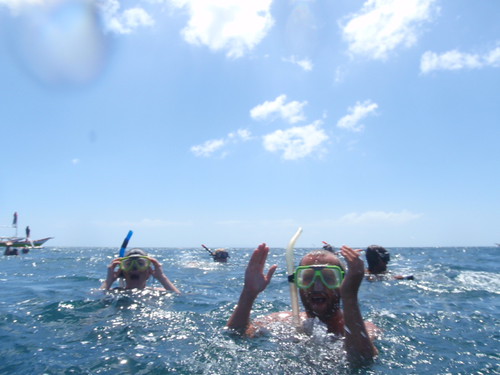
In the end it all went fantastically – practising the mask removal skills underwater was much easier this time, and then after that we got to swim around marvelling at the reef. It’s absolutely beautiful, and so peaceful down there. Diving itself is actually a very unenergetic activity, once you have your bouyancy levels right you just float around, with minimal effort from the legs, just taking in all the colours and the sights underwater. The different types of coral are stunning, and it’s such an amazing experience to have big schools of fish swimming right round you. Aquariums will never be the same. As well as all the fish and coral, we saw rays, lobsters (looking much happier than they do in tanks in restaurants, funnily enough), crabs, starfish, seahorses and some pretty cool eels. Only major disappointment for me was that we’d just missed the whale shark season, as they are supposed to be pretty spectacular.

Happy diver, cheesy grin

Happy diver, cheesy grin

Four dives and an exam later and we’d passed the course, meaning we
were able to spend our fun dives spending more time seeing the reef, and taking underwater pictures (which turned out to be the toughest of the skills I’d tried – managing to stay totally still to get the best picture takes a bit of practice, especially as your natural tendency is to hold your breath to stop bubbles getting in the way, and holding your breath makes you more bouyant, so before you know it you’re half way to the surface). All in all it was better than I could have hoped, and I definitely plan to do my advanced course when I get to Asia (especially if I can find a NAUI shop there, as you get to dive down to 40m on the NAUI advanced course as opposed to 30m with PADI).

→ 3 CommentsCategories: Honduras · Outdoor activities
Tagged: , , , , , , , , , ,

Mexico & Guatemala in pictures: Shop fronts

June 29, 2009 · 2 Comments

Mexico & Guatemala are very colourful countries in so many ways, from the food, to the landscapes and the traditional dress of the indigenous peoples. But my favourite of all are the hand-painted store fronts and advertising that brighten up every city in both countries. I wish we had this tradition back home.

You can see the rest of the set over at myFlickr page

→ 2 CommentsCategories: Art & Architecture · Guatemala · Mexico
Tagged: , , , , , , , , , , ,

Guatemala: Budget & Other Numbers

June 28, 2009 · 5 Comments

After narrowly scraping in under budget in Mexico, I was expecting Guatemala to be a hell of a lot cheaper.

In many ways it was – thanks to cheap chicken buses and short distances, I spent less than a fifth of what I had in Mexico on transport; similarly I was pleased to find that accommodation was much cheaper too.

Quetzales

Quetzales

Despite that, I still ended up far closer to my limit than I’d hoped, which is something I should have foreseen, for one main reason: my Spanish lessons. Coming in at $400 for two weeks, it accounted for 41% of my total spend and bumped my daily average up by nearly $20 per day. It was all worth it though, as it was the most fun I had in the country, and already it’s really helped me with my communication ever since.

The other surprise factor which is bound to affect any true Brit’s spending is the fact that beer is twice the price of that in Mexico. Now Gallo (the standard lager) and Moza (the delicious dark one) are good enough, but not really worth twice the price. Apparently the reason it’s so expensive is that the rich who dominate Guatemalan politics have ensured that income tax rates are among the lowest in the Americas, meaning the shortfall has to be made up with consumption taxes, which certainly hit the tourist harder.

Still, more expensive than I’d expected it may have been, but at least I still came in cheaper than Mexico. Total daily spend was $44.53, broken down as follows:
Transport – $2.38
Accommodation – $2.74
Activities (including the Spanish lessons and volcano hikes) – $19.46
Internet, laundry & postage – $1.64
Food & drink – $18.31

Other Numbers
Weird local gods paid homage to – 1
Hours of Spanish lessons – 40
Earthquakes felt – 1
Earthquakes slept through – 2
Active volcanoes climbed – 1
Buses – 13
Boat - 3
Cars – 2
Churches – 2
Beaches – 1
Beds – 6
Hot Springs – 1
Laundry – 3
Postcards – 2
Phone calls – 1
Cash withdrawals – 7
Museums – 1
Pyramids – 2
Tuktuks – 4
Kayaks – 1

People I studied & Salsa-ed with
Americans – 23
Canadians – 6
Guatemalans – 6
Brits – 3
Swiss – 3
Australians – 3 (at last)
French – 2
Belgians – 2
Mexicans - 1
Irish – 1
Germans -1
Kiwis – 1
Swedes – 1
South Africans – 1

Next stop: Honduras. And diving. Which is expensive.

→ 5 CommentsCategories: Guatemala
Tagged: , , , , , , , , , ,

Impressions of Guatemala

June 27, 2009 · 5 Comments

My first trip to Guatemala in 2007 was extremely brief – I spent just two days there on a brief visit from Mexico to see the Mayan city of Tikal – but it remains probably my best travelling memory. Tikal is the most amazing place I’ve visited, and viewing the sun rise over the jungle from the top of Temple IV was an experience that truly merits using the travelling cliche of ‘magical’.

Sunrise over Tikal

Sunrise over Tikal

That brief stop made me hungry to go back and see more, which is why I made it my second stop after Mexico. This experience was a very different one to the first – Tikal is in the remote, sparsely-populated Peten region of Northern Guatemala, whereas this time I spent my entire time in the highlands further south, where the majority of the population live.

In many ways Guatemala has a lot of similarities with Mexico, especially the southern state of Chiapas (both share a high indigenous Mayan population). The food is pretty similar – lots of tortillas, rice and beans, although the quality and variety of streetfood was nowhere near as good as Mexico, and the chili sauces disappointingly mild. The volcanic landscape of the highlands in many places looks similar to Mexico. The Spanish colonial cities share similar histories and architecture (in particular Antigua looks very like San Cristobal de las Casas).

In other ways the two countries are very different. The indigenous population of Mexico is very much in the minority, whereas Guatemala has the highest indigenous population of any country in the Americas, and it’s very noticeable (one of the plus sides to this for me was that Guatemala is the first place in the world I’ve ever felt tall, which is saying something). Probably the biggest difference for me was the number of other tourists – after swine flu and the drugs war kept Mexico pretty gringo-free, it was a shock to the system to visit somewhere where there were so many.

Huehuetenango

The Pyramids of Zaculeu

The Pyramids of Zaculeu

My first stop was Huehue, the closest big city to the border withe Mexico. It was instantly obvious that the city was much poorer than anywhere I’d experienced so far, and one symptom of that was that when we went looking for a bar to have a relaxing drink after a hard day of traveling, we were amazed to find there is only one in the entire centre. Which was obscenely expensive – which came as a surprise, seeing as I’d expected Guatemala to be cheaper than Mexico. In fact, it generally is, the biggest difference being that beer and other alcohol is generally double the price of its northern neighbour. The other expensive thing in our time there was our visit to the Mayan ruins of Zaculeu – worth a visit because the restoration carried out by the United Fruit Company in the 1950s actually makes them look far closer to how pyramids would have looked originally than in other sites with more sensitive restoration – but which were more than double the cost to visit of any of the far more impressive ruins in Mexico.

Xela

Chicken Buses

Chicken Buses

Getting from Huehue to Xela was pretty cool, as it was my first experience of the legendary chicken buses, old US yellow school buses that have been shipped down south, painted in glorious technicolor patterns and put to service plying the steep and winding highways of Guatemala. I loved Xela too – my first impressions weren’t that great, but over the couple of weeks I got to spend there I fell in love with the place. There were very few tourists there, instead most of the foreigners there are language students, giving the town a bit of a college town feel.

One of the other great things about the town, unlike the places I would visit later, is that ther gringos don’t hang out in gringo ghetto bars, instead everywhere I went had a good mix of Guatemaltecos and foreign students (most noticeably at Bar Rumba, where it was always entertaining to watch the locals salsa-ing away expertly while most of us foreigners spent more time tripping over our feet trying to copy them).

The market of San Francisco el Alto

The market of San Francisco el Alto

It’s also a great city to base yourself for a while, as there’s loads to do nearby, including the volcanic hot springs of the Fuentes Georginas (the water was so hot it was like being in a bath), and treks to the variosu nearby volcanoes. Probably most interesting of all was getting to visit the nearby market of San Francisco el Alto, the largest market in Central America. Unlike the more famous market of Chichichastenango, which specialises in artsenias and therefore is quite a tourist magnet, this market is very much a general market, selling pretty much everything under the sun in stalls crammed into the narrow winding lanes of this mountain town. Highlight for me was the main square at the highest point in the town, where locals were selling sheep, goats, pigs, turkeys, cows, dogs, cats and geese, none of them kept in pens, giving the place quite a chatoic feel. It was quite and impressive sight watching little old indigenous women struggling to wrestle a newly purchased (and very reluctant piglet) into a bag to take home.

Lake Atitlan

View over Volcan San Pedro & the Lake

View over Volcan San Pedro & the Lake

There’s no other way to describe it, Lake Atitlan is simply stunning. High up in the western highlands, the lake is completely surrounded by high mountains and extinct volcanoes, with pretty little villages, each with a different character clinging to the sides. Being this beautiful, it’s no surprise that bit’s very much a tourist magnet – in fact I saw more tourists around the lake than I had anywhere so far in my trip. I stayed in San Pedro la Laguna, the backpacker village (others include Panajechal, the most touristy; San Marcos, full of new age types and therefore the best place to go if your aura needs a good cleaning ro you have wonky chakras that need aligning; and Santiago Atitlan, the most indigenous of all the villages), and spent a very pleasant few days, chilling by the lake, kayaking across it to San Marcos and back, and hiking up the Nariz de Indio (Indian’s nose), which gave spectacular views across to the volcanoes and over the lake.

Antigua Guatemala

On the streets of Antigua

On the streets of Antigua

Antigua is a very different place to the rest of the country. It was the colonial capital until late in the 18th century when a series of earthquakes nearly destroyed the city. Now, most of the colonial buildings have been restored and are painted in bright colours; meanwhile many of the huge former convents and churches still lie in impressively ruined states dotted around the city. As the obvious tourist highlight of the country, the government has ensured the city is cleaner and safer than the rest of the country – it’s been said that this is what Guatemala would be like if it was run by the Swiss. I must admit that despite its stunning beauty, I didn’t enjoy it as much as I had the colonial cities of Mexico, mainly because the city seems to be mainly populated by foreigners, giving it quite an un-Guatemalan feel compared to Xela. Don’t let that put you off though – I think I’ve just been spoilt by elsewhere.

Mayan weaving in Santiago Atitlan

Mayan weaving in Santiago Atitlan

One of the best things about the country is that so much is crammed into such a relatively small space (the whole country is about the size of England), and if any of you back home are jealous of my travels, Guatemala would make a pretty perfect place to take a two-week holiday, as in that time you could see one of the best preserved colonial cities in the Americas, see one of the world’s most beautiful lakes, hike active volcanoes, get to see amazing ruins, as well as seeing how the descedents of the Mayans who built them still have a traditional culture that’s very much alive to this day.

You can read any of my posts about Guatemala here and see all my photos from the country here.

→ 5 CommentsCategories: Guatemala
Tagged: , , , , , , , , , , , , , , , , , , ,

Getting close to the lava

June 25, 2009 · 5 Comments

If there was an active volcano in the UK, you wouldn’t be allowed within a mile of it, let alone be able to climb it.

Lava flow on Volcan Pacaya

Lava flow on Volcan Pacaya

So when I found out that Antigua had one on its doorstep, that you could not only climb but also get really close to the lava, I didn’t have to think twice. I wasn’t going to let anything put me off, even the fact that so far I’d met two people who’d climbed it, and both had manage to injure themselves – both by slipping on the loose rock and cutting their legs on the very jagged rocks, one of whom so badly that he needed stitches. I’m very glad I met them though, as they both advised me not to ignore the little kids who hang around at the bottom waiting to meet climbers so they can hire them sticks for a very reasonable price, which are very handy for providing an extra means of support.

I’m becoming increasingly accustomed to early starts (I think I’ve been up at 6am or earlier more times the last few months than I have done in years), so it was no surprise that we had to be picked up at 6am, to make it up the mountain before the rains came, and after a couple of hours’ driving we found ourselves at the foot of the trail.

After the extreme exertion of climbing Volcan Santa Maria in Xela, I was hoping for an easier ride this time round, and I was not disappointed. The trail wasn’t too steep at all compared to my previous experience, and it took far less time, as the volcano itself is much smaller (being relatively young). We were lucky enough to be in quite a small group, and all of relatively similar fitness, so we made it up through the treelined lower slopes of the volcano pretty quickly and soon emerged at the dried lava fields that surround the active vent.

That’s where the tricky bit begins – the dried-out lava is extremely sharp, and very very uneven. Much of it is in the form of loose rocks, meaning your footing is likely to give way at any moment, and I could quite see how my friends had managed to injure themselves. So we very carefully made our way across the path towards the vent, being very glad of the sticks we’ds hired at the bottom (especially when we saw a German woman fall, cutting her leg so badly she couldn’t walk any more and had to wait for a horse to make its way up the mountain to carry her back down. Others had less trouble, most notably being the local dog that appeared to live on the mountain (and whose fur had taken on a really golden-orange colour, presumably from all the sulphur in the air).

Volcanic dog

Volcanic dog

The lava runs in various pipes close to the surface, and has several vents, so having a guide to make sure you don’t end up walking in the wrong place was crucial – as it is, in several places you could feel the heat on the rocks as you leant on them, knowing fresh lava was running just beneath. Finally we made it to the main lava flow – and it certainly wasn’t a disappointment. Watching red hot molten lave running down the hillside just a couple of feet away from me was truly one of the most spectacular things I’ve ever felt. It was also one of the hottes, unsurprisingly enough. We were lucky enough most of the time to have the wind behind us; on a couple of occasions it turned to blow towards us and it was like standing in a furnace.

The lava vents

The lava vents

The final ascent (which took a bit of queueing) took us up to see the vents themselves – right next to each other, two openings in the ground where the lava pour out of the ground. The lava is so hot that there were people toasting marshmallows over it – and it took just a couple of seconds for them to blacken, and that’s with the stick a few feet away.

Toasting marshmallows

Toasting marshmallows

Experiences like these are really one of the reason I love travelling – I could never do anything like that back home, and it’s given me a memory I’ll never forget. You can see all of my photos of Volcan Pacaya and the beautiful colonial city of Antigua here.

→ 5 CommentsCategories: Guatemala
Tagged: , , , , , , , , , ,

Mapping my journey

June 24, 2009 · 5 Comments

After weeks of being massively behind on my blogging, it turns out all it takes to catch up is being in a city where it’s too dangerous to even go 50m from the hotel without being mugged once it gets dark (that’s Bogota, Colombia, by the way).

Anyway, I’ve now got all my photos uploaded to Flickr and I’ve written all my blog posts about Guatemala, Honduras & Miami. They’ll be appearing over the next few days, but in the meantime, thanks to popular demand (well, one request from my friend Will, actually) I’ve now added a page with a map showing where I’ve been so far, as well as links to all the photos and posts to date, and a rough itinerary of where I’ll be heading next.

Time will tell whether or not I actually manage to keep it up to date, but at the moment it seems like a good idea.

→ 5 CommentsCategories: Travel Lists
Tagged: , , ,

Learning Spanish in the Guatemalan Highlands

June 23, 2009 · 13 Comments

After spending a week studying Spanish in Xela, I made a last minute decision to switch to PLQ’s sister school up in the mountains. It hadn’t been part of my original plans, but on speaking to some of the students who’d studied there it really sounded like an experience not to be missed, and so was very glad to find last minute places available.

La Escuela de las Montañas (the Mountain School) is situated about 10km north of Xela, in the surrounding highlands, one of the finest coffee-growing regions in the world, although it takes an hour to get there because of the winding roads that lead up into the mountains. It very much shares the same philosophy as its sister school, but the key difference is it’s actually situated right next door the communities it helps, meaning you really get a better understanding of Guatemalan village life that most travellers probably don’t get to see.

Cows on the streets of Fatima

Cows on the streets of Fatima

The neighbouring communities of Fatima and Nuevo San Jose are both made up of families who formerly lived and worked on nearby coffee fincas. After the collapse of world coffee prices in the 90s, the owners of the fincas simply stopped paying the workers for two years. The situation got so desperate that eventually children died of malnutrition, and the children missed out on school for the whole time as well. In both cases the workers took the owners to court, and won. In one case, they eventually got some of the money they were owed after this; in the other the owners still failed to pay up, and in frustration the community eventually took the owner hostage until he paid up. With the money they gained, they were able to buy some land and build houses. However the situation is still pretty desperate, with very few of the people in both communities having regular jobs – instead most of the men get up at 4am every morning to get a bus into town to look for casual work, which is by no means guaranteed. What work there is is often well below the minimum wage (which is very hard to enforce in Guatemala).

So the mountain school was set up to teach Spanish and use the profits to help out both communities financially, both by paying families to provide meals for students, and by providing funding for the communities’ special projects fund. At the moment, they are also trying to find the funds to help build a library and computer centre for the children of both communities, to help their education, something which is expensive for families with very little money.

It’s a rather over-used word, but eating three meals a day with my host family was quite a humbling experience – after staying with a middle class family in Xela with a big house, it was quite a contrast to be eating in a tiny dirt-floored shack made of corrugated metal, just one pretty small room divided by a curtain, serving as a home for a whole family, with the bed in one half and the cooking area in the other. There’s no electricity, running water or toilet in the house – those are all shared with other neighbours, and cooking is simply on a makeshift wood-burning stove. Despite these difficulties, I actually ate more and better than I had with my family in Xela, and every breakfast I was entertained by Jessica, the family’s two year old daughter who chatted away to me in incomprehensible Spanish while I ate. Everyone in the village is incredibly friendly too – with up to fourteen foreign students turning up every week, and only around forty families in both communities, they are quite used to our strange ways, and the kids are always running up to you demanding you take a photo of them (which they always love seeing), or even just to stop and play games or dance in the street with them.

Friendly local kids

Friendly local kids

The school itself is a little oasis of calm – the main building (where we all sleep) is surrounded by a huge garden, containing banana and coffee trees, a traditional medicinal herb garden and a carp pond. All lessons also take place in little palm-thatched cabañas in the garden, which is a lovely way to study (if there is such a thing as a lovely way to study). There’s also a little mirador (look-out), where you can sit and read, or study, or just chill out, overlooking the valley and the adjacent mountains. The terrace of the school also has hammocks for relaxing too, and there’s a kitchen as well just in case you are still hungry (or you can do what we did and get a friend to visit from Xela with pizza). Being in such small place, there’s little to do of an evening but chill out, chat, and play cards outside over a beer or two, listening to the rain and watching the skies light up with the tremendous electrical storms that happen every evening at this time of year. The house also has two lovely cats and three adorable dogs guarding the place (they bark at every passing vehicle, but unfortunately living in a humid and rainy climate they are bit too smelly – despite regular baths – to really play with).

My classroom

My classroom

As well as all the classes, you also get more of a feel for the community by the various other talks the school organises – one night the village midwife came to give us a talk about how she works, and the difficulties she faces, one lunchtime we had a talk from a local who is involved in running the local community radio station that has a crucial role in providing information about health and education, and most fun of all was the night one the local mothers came down to teach us how to make platanos rellenos (stuffed bananas), which involved boiling up bananas until soft, mashing them up to make a dough, rolling them out to make banana tortillas, and then stuffing them with pureed sweetened black beans, and then deep-frying the whole thing and serving with sugar – great fun and absolutely delicious.

Making platanos rellenos

Making platanos rellenos

The whole thing has been a magical time, so relaxing and enjoyable I barely feel like I’ve been studying, and getting the chance to experience at close hand the realities of how the majority of Guatemalans live is something I’ll never forget. It’s a shame I have to get on because I’d love to stay here for several weeks, slowly improving my Spanish (many students do just that).

Cheesy graduation picture

Cheesy graduation picture

If you’re thinking of studying Spanish in Latin America, I really can’t recommend this place highly enough (you can find out more about it here), I genuinely can’t think of a better place to do it, plus you get the chance to help an extremely poor community.

→ 13 CommentsCategories: Guatemala
Tagged: , , , , , , , , , , , , , , , , , , , , , , , , , ,